On the morning of October 5, 2026, in Hanoi, the Academy of Public Administration and Governance, in collaboration with the United Nations Development Programme (UNDP) and the Eastern Regional Organization for Public Administration (EROPA), organized the 2026 Annual International Forum on Public Governance under the theme: "Inclusive Governance in the New Era of Development: Systems Transformation, Innovations and Future-Ready Governments"
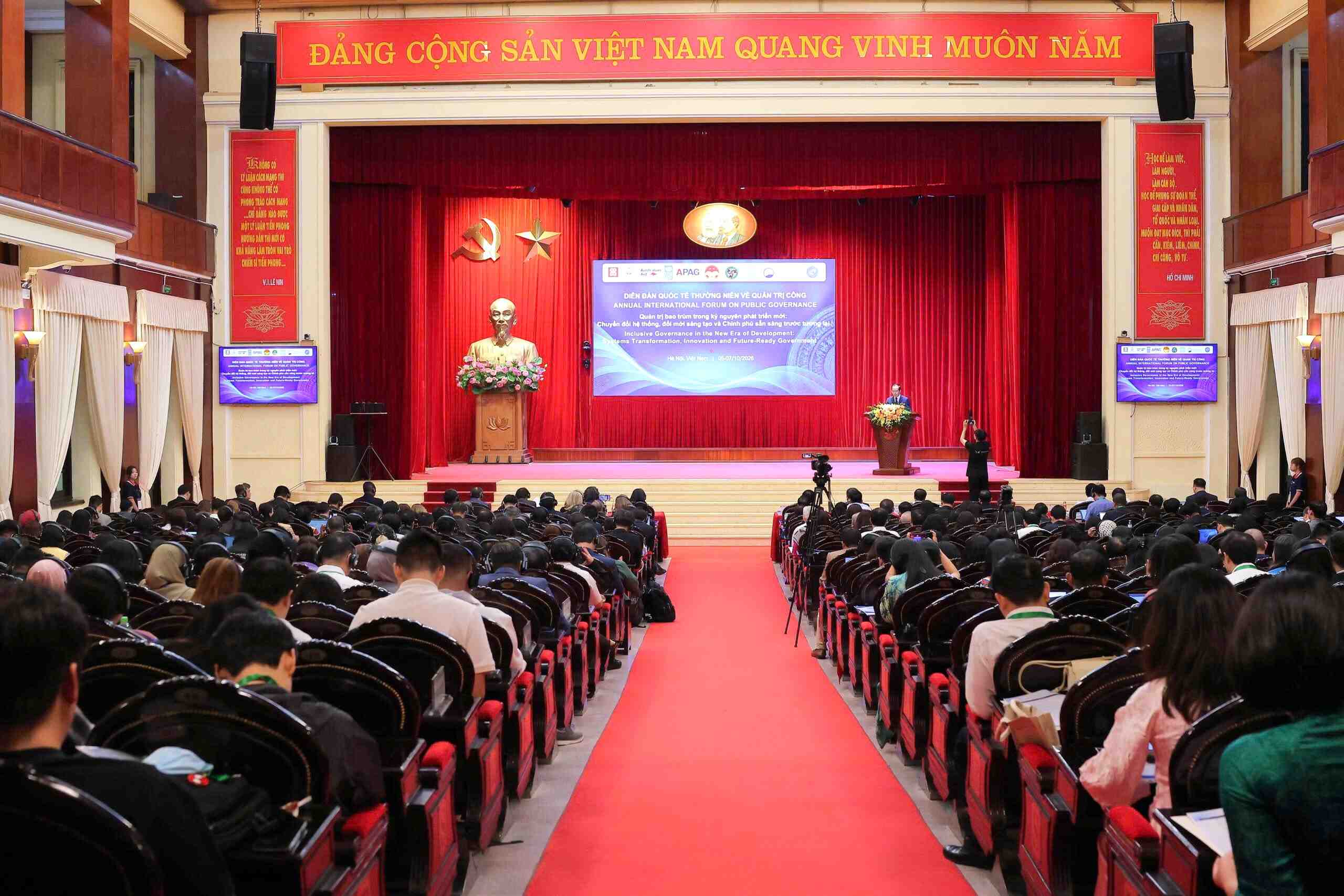 Overview of the forum
Attending the forum, on the side of the Ho Chi Minh National Academy of Politics and the Central Theory Council, were Prof. Dr. Nguyen Xuan Thang, Chairman of the Central Theory Council, Former Member of the 13th Politburo, and former President of the Ho Chi Minh National Academy of Politics; Assoc. Prof. Dr. Nguyen Manh Hung, Vice President of the Academy and Vice Chairman of the Central Theory Council; Assoc. Prof. Dr. Nguyen Duy Bac, Vice President of the Academy; Prof. Dr. Nguyen Quoc Suu, Assistant to the Politburo member and President of the Academy; Dr. Truong Cong Dac, full-time deputy secretary of the academy's party committee, alongside leaders of functional departments, specialized institutes, regional academies, and the Academy of Journalism and Communication.
From the Academy of Public Administration and Governance, participants included Assoc. Prof. Dr. Nguyen Ba Chien, President of the Academy; Vice Presidents of the Academy; leaders of affiliated and subordinate units, faculty members, trainees, and doctoral candidates.
On the side of the co-organizing international organizations, representatives included Ms. Pauline Tamesis, United Nations resident coordinator in Vietnam; Ms. Ramla Khalidi, resident representative of the United Nations Development Programme (UNDP) in Vietnam; Prof. Dr. Alex Brillantes, Secretary-General of the Eastern Regional Organization for Public Administration (EROPA); Mr. Changseob Han, Head of the United Nations Project Office on Governance (UNPOG/UN DESA); Ms. Karen Dalkie, Vice President of the Canadian Bureau for International Education (CBIE); Assoc. Prof. Dr. Sirisak Laochankham, Dean of the College of Public Affairs & Policy (COPA, Khon Kaen University, Thailand); Dr. Kristoffer Berse, Dean of the National College of Public Administration and Governance (UP-NCPAG, University of the Philippines) and Deputy Secretary-General of EROPA; and Mr. Heng Whoo Kiat, Director of Government projects at the Chandler Group of Governance (CGG).
On the side of diplomatic missions and international organizations, participants included H.E. Rogelio Polanco Fuentes, Ambassador Extraordinary and Plenipotentiary of the Republic of Cuba; H.E. João Pereira, Ambassador Extraordinary and Plenipotentiary of the Democratic Republic of Timor-Leste; representatives from the embassies of Australia, Canada, France, Laos, South Korea, Singapore, and the United States; representatives from Global Affairs Canada, JICA Vietnam Office, the German Agency for International Cooperation (GIZ), and the Vietnam - Australia Centre.
On the side of domestic agencies and local authorities, attendees included Dr. Tran Anh Tuan, President of the Vietnam Administrative Science Association and former Vice Minister of Home Affairs; Assoc. Prof. Dr. Trieu Van Cuong, former Vice Minister of Home Affairs; and Mr. Vu Hoang Anh, Deputy Secretary of the Lang Son Provincial Party Committee.
In addition, the forum welcomed a large number of scholars, scientists, and leaders from ministries, sectors, localities, and universities across 11 countries in the region and the world, including Australia, Bangladesh, China, India, Indonesia, Japan, Malaysia, Nepal, the Philippines, South Korea, and Thailand.
Inclusive governance in the new era: Strategic vision and national execution capacity
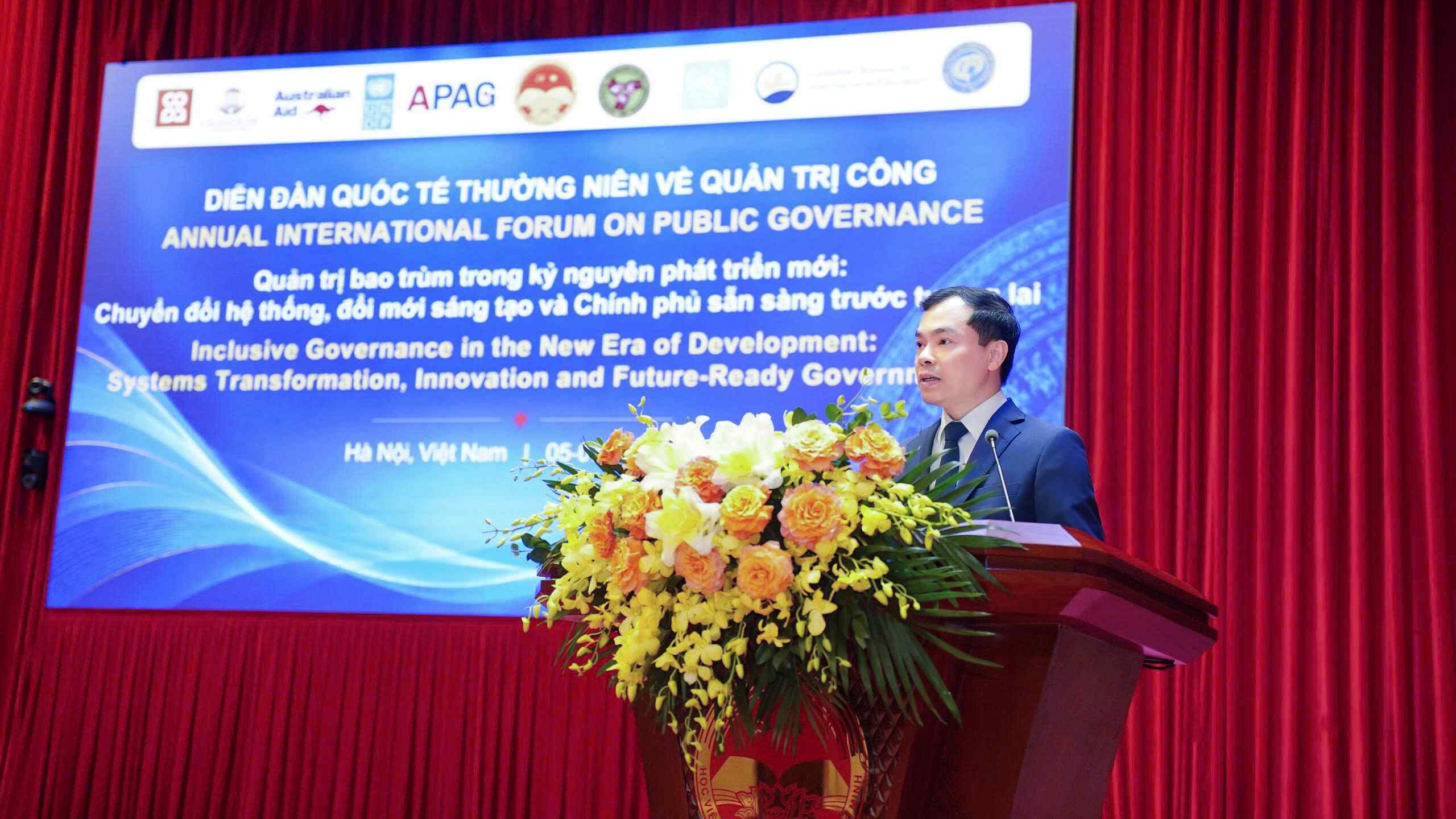 Assoc. Prof. Dr. Nguyen Manh Hung, Vice President of the Ho Chi Minh National Academy of Politics and Vice Chairman of the Central Theory Council, delivers the opening address
Delivering the opening address at the 2026 Annual International Forum on Public Governance, Assoc. Prof. Dr. Nguyen Manh Hung, Vice President of the Ho Chi Minh National Academy of Politics, emphasized that Vietnam enters a new era of development after 40 years of Doi Moi, aspiring to become a developed, high-income country by 2045. To translate this vision into feasible policies that yield tangible outcomes for citizens, national governance capacity plays a pivotal role.
The Vice President of the Ho Chi Minh National Academy of Politics affirmed that the forum's theme reflects the alignment of three core elements: systemic transformation creating the foundation, innovation driving breakthroughs, and enhanced adaptive capacity ensuring government future-readiness. Vietnam is accelerating administrative organizational reform, operating a two-tier local government model, promoting decentralization and delegation of power, and driving digital transformation to form a governance ecosystem that meets current demands and proactively adapts to the future.
Assoc. Prof. Dr. Nguyen Manh Hung noted that a future-ready government needs to foster an anticipatory governance mindset, proactively respond to major unforeseen events ("black swans"), and translate forecasting capabilities into concrete actions through collaboration among public authorities, academia, businesses, and communities. Simultaneously, the application of innovation and artificial intelligence must go hand in hand with data protection, accountability, and maintaining human-centered, inclusive goals.
Furthermore, building inclusive governance requires international cooperation to address global challenges such as climate change, artificial intelligence safety, and population aging. Assoc. Prof. Dr. Nguyen Manh Hung expressed hope that the forum would serve as a practical exchange space, contributing to turning shared visions into practical capabilities and shaping a better future together with the people.
Elevating implementation capacity and creating public value
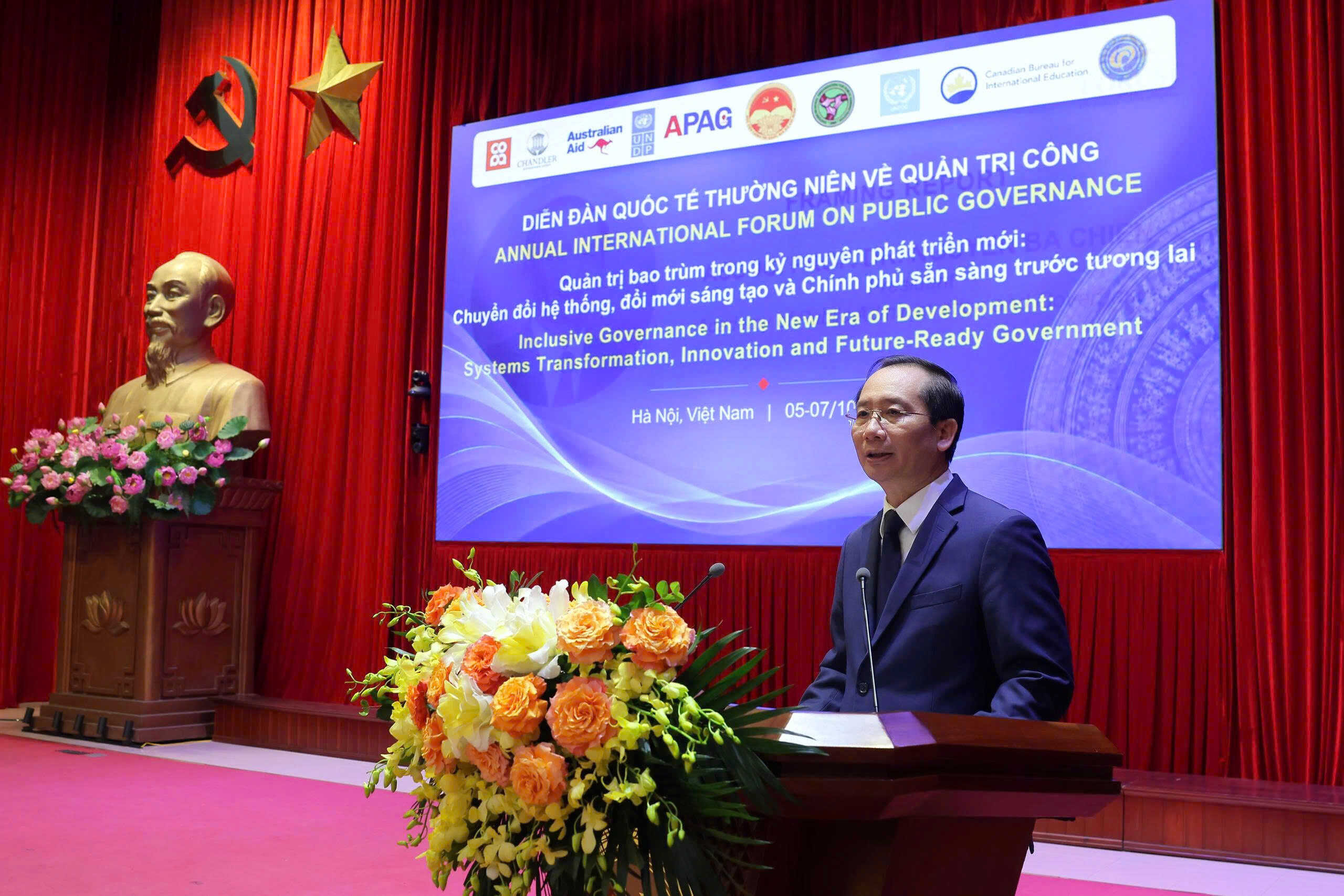 Assoc. Prof. Dr. Nguyen Ba Chien, President of the Academy of Public Administration and Governance, delivers the introductory address
Delivering the introductory address, Assoc. Prof. Dr. Nguyen Ba Chien, President of the Academy of Public Administration and Governance, highlighted the imperative for governance innovation amidst rapid and unpredictable global changes. Accordingly, systemic transformation, innovation, and building future-ready governments must be pursued to enhance implementation capacity, resolve development challenges effectively, and ensure inclusive outcomes.
From this perspective, Assoc. Prof. Dr. Nguyen Ba Chien proposed three key themes for experts, scholars, and scientists to discuss at the forum.
First, systemic transformation must generate better implementation capacity. Organizational, authority, procedural, and technological changes hold true meaning only when they elevate the ability to resolve real-world tasks. Therefore, in operating the new organizational structure, the two-tier local government model, decentralization, delegation of power, and digital transformation, special attention must be paid to alignment between authority and implementation conditions, clarity of responsibilities, inter-sectoral and inter-level coordination efficiency, and service quality for citizens and businesses. This also serves as the basis to verify the effectiveness of systemic transformation at the local level, where policies are executed and development issues are directly addressed.
Second, driven by the need to elevate execution capacity, governance today must become a problem-solving capacity under volatile conditions. This requires early identification of changes, utilization of data and evidence, coordinated action, and timely policy adjustments. Innovation, data, and artificial intelligence expand problem detection capabilities, support decision-making, and organize execution, but simultaneously demand high data quality, accountability, and risk control. More importantly, the governance system must possess the capacity for continuous learning from practice to adapt to unforeseen fluctuations.
Third, outcomes and public value must serve as crucial metrics for development governance capacity. Alongside compliance with laws, proper authority, and procedures, governance quality must be demonstrated through problem-solving effectiveness, public service improvement, reduction of social costs, and expanded opportunities for equitable access and benefit. On this basis, decentralization, delegation of power, digital transformation, innovation, and artificial intelligence applications must all be evaluated by the tangible value they bring to citizens, enterprises, and society.
Assoc. Prof. Dr. Nguyen Ba Chien noted that the 2026 Annual International Forum on Public Governance brings together a wide array of domestic and international delegates, experts, and scientists across numerous presentations and panel discussions, reflecting broad interest in development governance. The Academy of Public Administration and Governance reaffirms its bridging role between theoretical research, practical summaries, and policy advisory, striving to contribute valuable research findings to training, capacity-building, and national and local development governance. Building on the forum's success, the academy looks forward to expanding cooperation with EROPA, UNDP, international organizations, academies, universities, and research institutes to promote joint research, share experiences, translate research findings into practice, and enhance knowledge exchange between Vietnam, the region, and the international community.
Strengthening international cooperation for inclusive governance and sustainable development
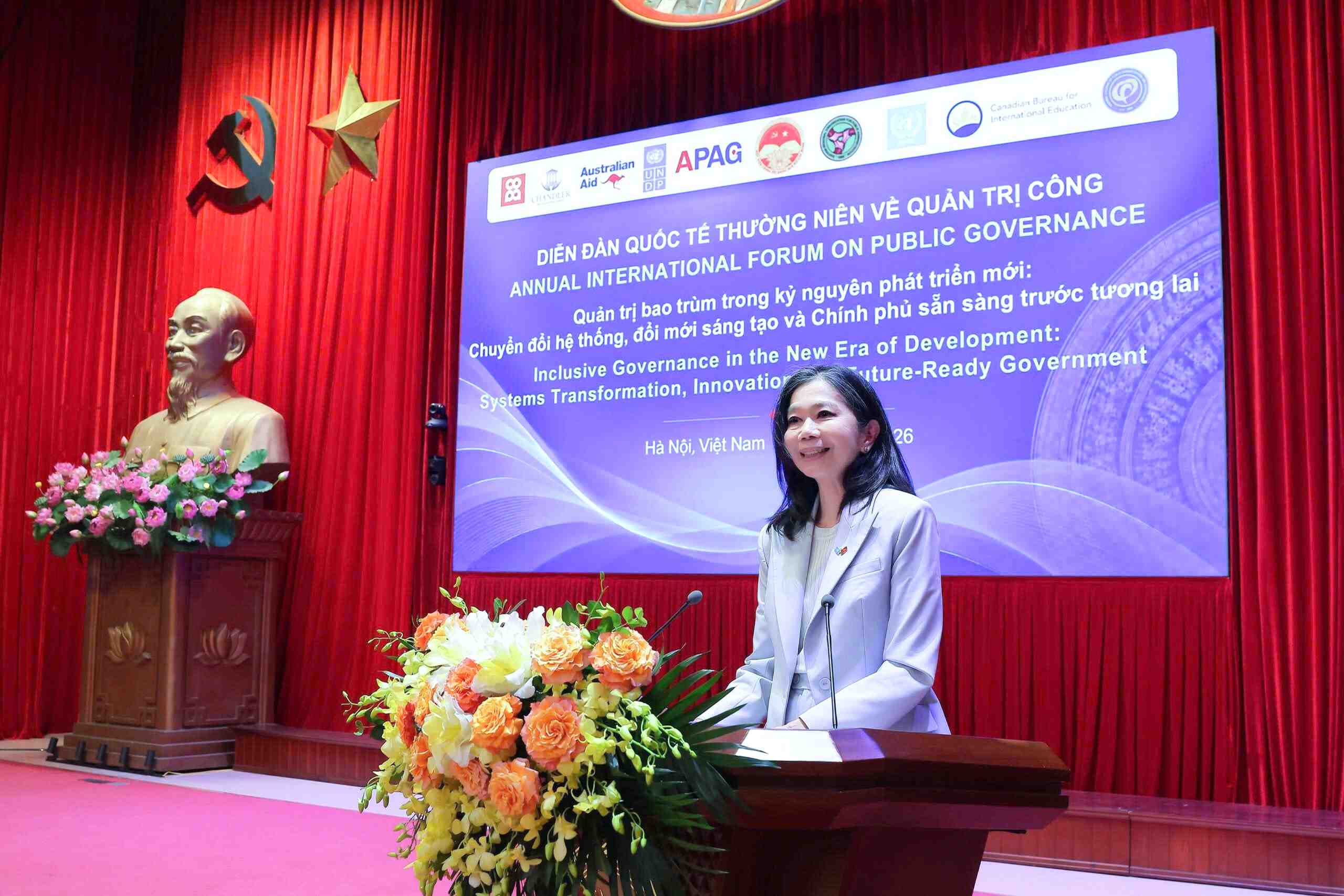 Ms. Pauline Tamesis, United Nations resident coordinator in Vietnam, delivers remarks
Speaking at the forum, Ms. Pauline Tamesis, United Nations resident coordinator in Vietnam, emphasized that artificial intelligence governance and inclusive digital transformation are key to serving human development and mitigating inequality. Although artificial intelligence offers immense potential, without robust and inclusive international frameworks, this technology risks concentrating power and widening development gaps. Therefore, technology governance must be anchored in normative foundations such as the United Nations Charter, the 2030 Agenda for Sustainable Development, and the Global Digital Compact to ensure technology serves humanity and narrows social inequalities.
To realize this objective, Ms. Pauline Tamesis proposed two strategic directions for public governance. First, institutionalizing an inclusive multi-stakeholder governance model. Governments cannot tackle systemic challenges in isolation; they must integrate private sector agility, community knowledge, academic research, and lived experiences of all social strata, particularly vulnerable groups, while protecting human rights and gender equality online. Second, building a future-ready government by investing in safe public digital infrastructure, implementing evidence-based disaggregated data governance, and deploying risk-based artificial intelligence governance frameworks to prevent algorithmic bias.
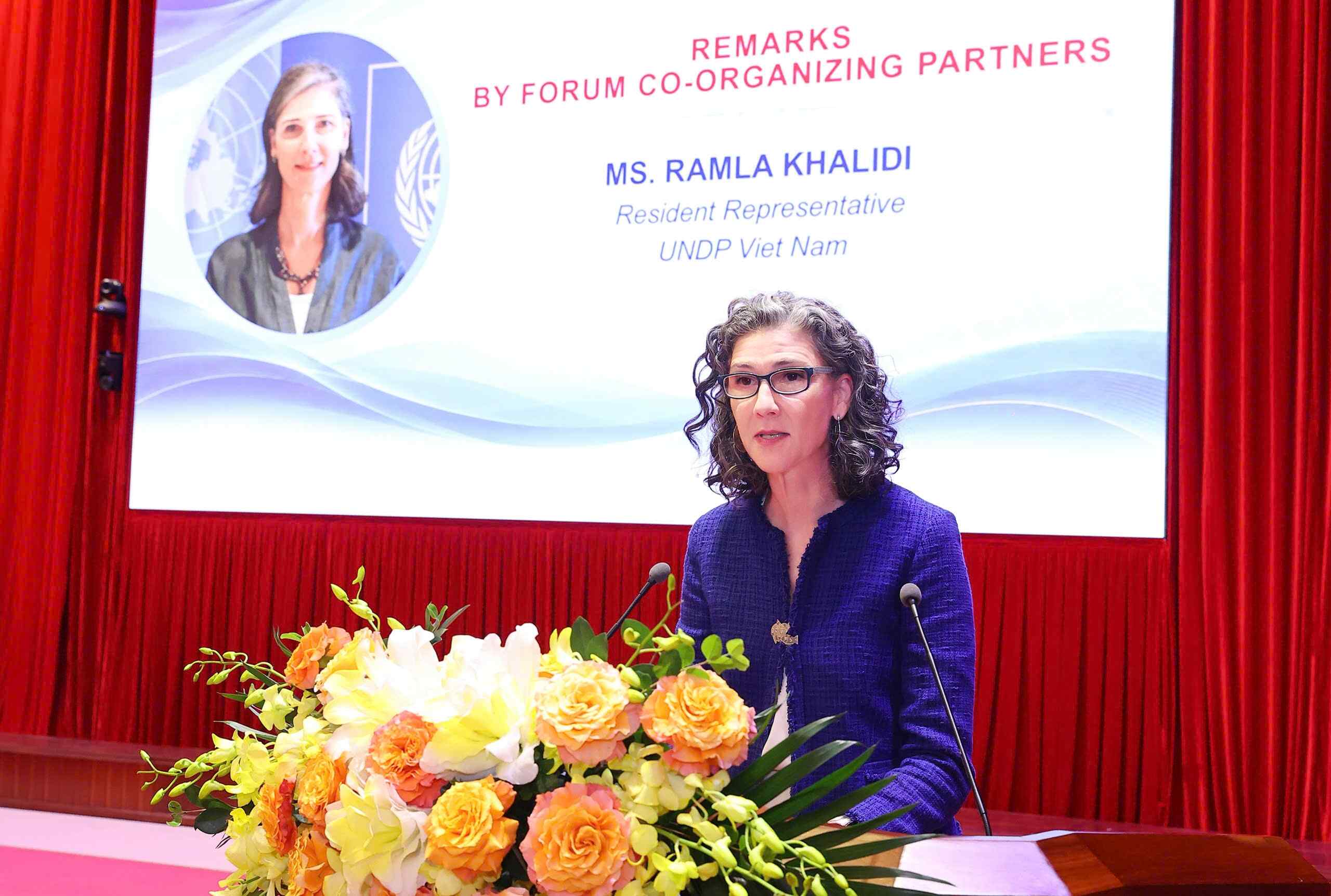 Ms. Ramla Khalidi, UNDP resident representative in Vietnam, delivers remarks
Speaking at the program, Ms. Ramla Khalidi, UNDP resident representative in Vietnam, noted that digital transformation and artificial intelligence create new opportunities for governance, public service delivery, and innovation, but could also exacerbate inequalities if citizens lack equal access to digital infrastructure, tools, and skills. In this context, inclusive governance must ensure technological transformation leaves no one behind, especially vulnerable groups.
For Vietnam, alongside positive achievements in connectivity, digital public services, and innovation, the coming phase needs to focus on three priorities: universal digital connectivity, building digital skills and capacity, and governing artificial intelligence transparently, responsibly, inclusively, and in service of the public interest. The core of a future-ready government is placing people at the center, combining innovation with inclusion, efficiency with trust, and technological advancement with human development.
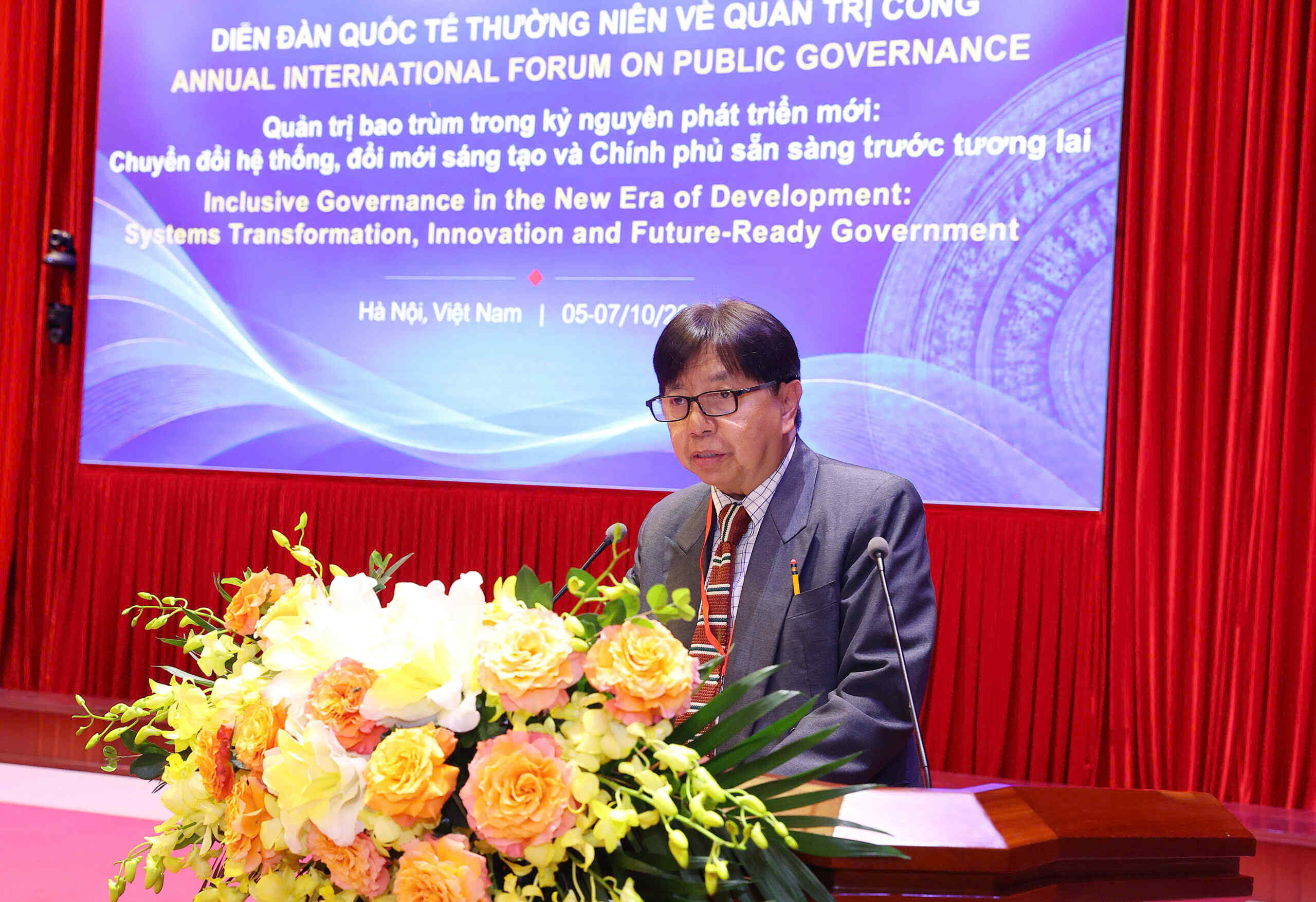 Prof. Dr. Alex Brillantes, Secretary-General of the Eastern Regional Organization for Public Administration (EROPA), delivers remarks
Affirming the effective and enduring partnership between the Eastern Regional Organization for Public Administration (EROPA) and the Ho Chi Minh National Academy of Politics across international conferences, Prof. Dr. Alex Brillantes, secretary-general of EROPA, stated that the forum's focus on inclusive governance, systemic transformation, and innovation is especially timely amidst the explosion of artificial intelligence and global technological shifts. Moving beyond identifying risks or analyzing challenges, Prof. Dr. Alex Brillantes emphasized the spirit of "positive public administration," which aims to build practical, constructive policy solutions that offer hope to society. Accordingly, modern public governance prioritizes not only efficiency and resource optimization, but above all ensures equity, focuses on vulnerable groups and future generations, and strictly upholds ethical standards and accountability to serve the public.
Innovating national governance in the new development era: Strategic orientations for Vietnam
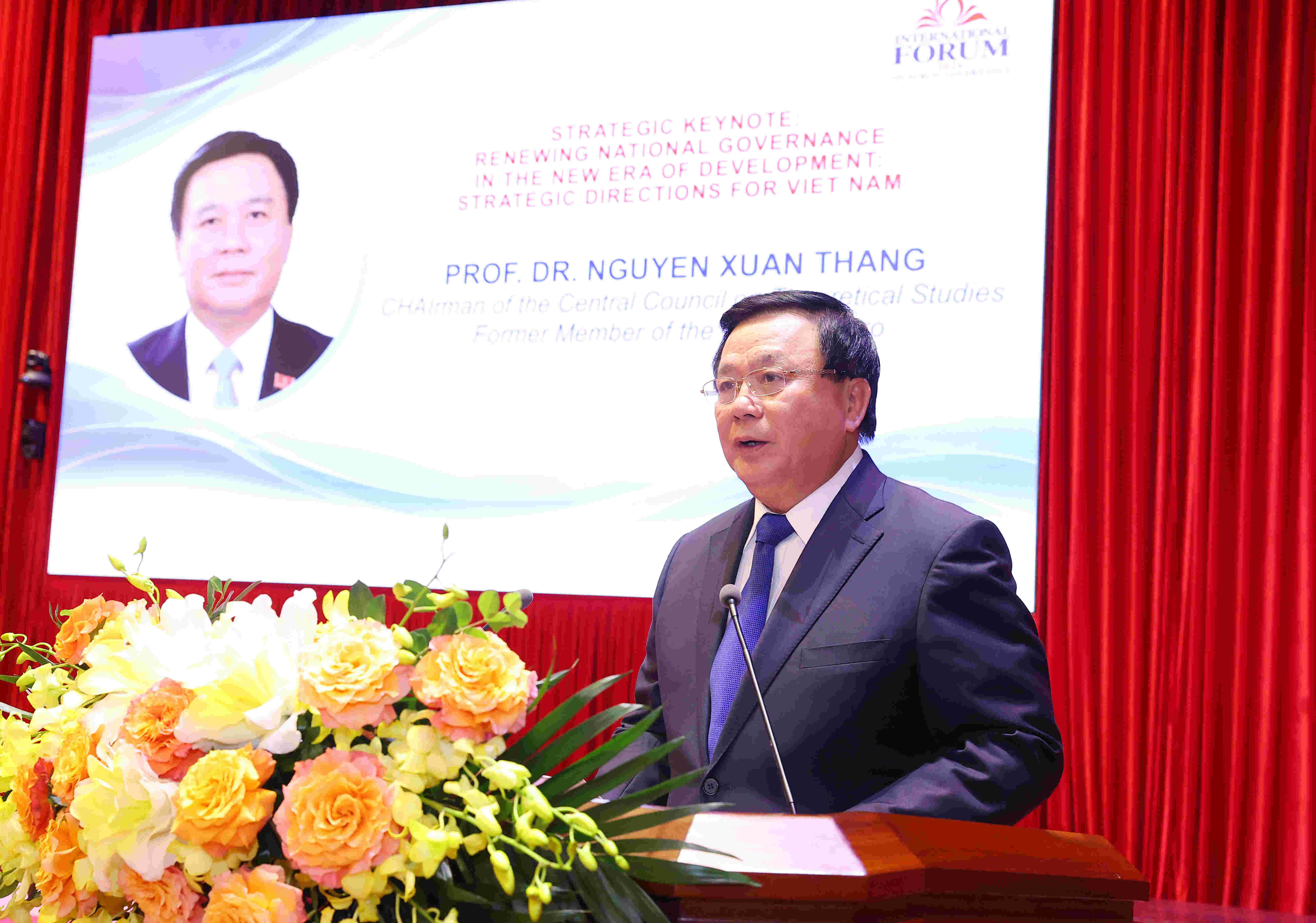 Prof. Dr. Nguyen Xuan Thang, Chairman of the Central Theory Council and member of the 13th Politburo, delivers remarks
Speaking at the forum, Prof. Dr. Nguyen Xuan Thang, Chairman of the Central Theory Council and member of the 13th Politburo, emphasized that national governance innovation is a decisive factor in bringing Vietnam into a developed, high-income nation by 2045 amidst global volatility. To realize this goal, Prof. Dr. Nguyen Xuan Thang proposed four strategic orientations. First, the State needs to elevate its developmental creation capacity by accurately identifying priorities and effectively allocating and connecting strategic resources to optimize execution results. Second, building high-quality institutions must move a step ahead to resolve bottlenecks and create flexible frameworks for new drivers such as artificial intelligence, green technology, and the digital economy, while narrowing the gap between policy decisions and reality. Third, the nation must proactively cultivate strategic capacity and self-reliance through data-driven anticipatory governance mindsets, flexible adaptability, and elevated positions in global value chains.
Prof. Dr. Nguyen Xuan Thang affirmed that human development and social capacity serve as the long-term foundation, focusing on elevating civil service quality, strengthening linkages between the State, enterprises, and community, and ensuring inclusion so all strata of society participate in and benefit from development achievements.
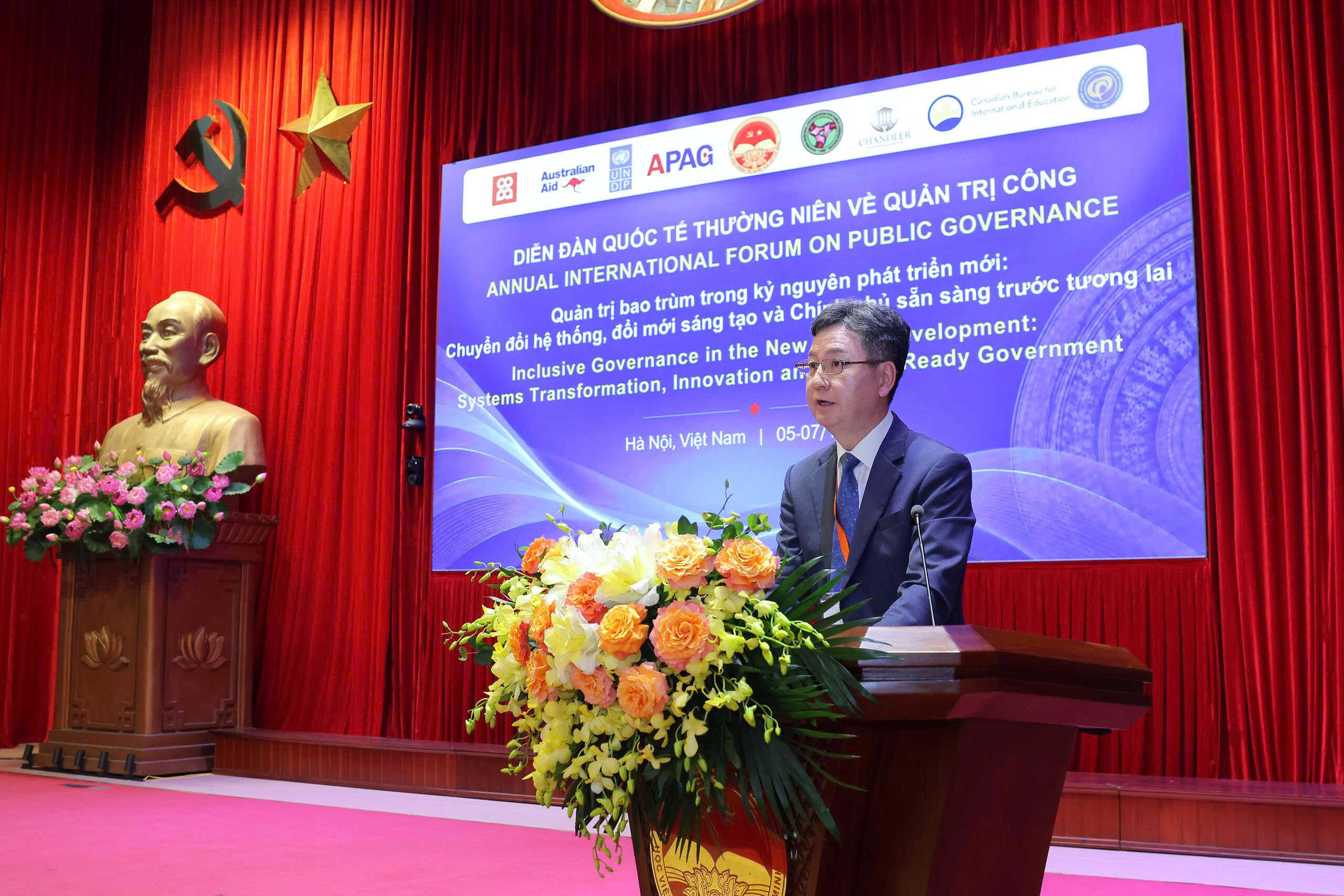 Mr. Changseob Han, head of UNPOG/DPIDG/UN DESA, delivers remarks
Speaking at the forum in Hanoi, Mr. Changseob Han, head of UNPOG/DPIDG/UN DESA, commended the roles of EROPA and the Academy of Public Administration and Governance in organizing and connecting experts, managers, and representatives of international organizations to discuss pressing public governance issues in the new development era. The forum takes place as nations face economic, social, technological, and environmental shifts, demanding inclusive, effective, accountable, and adaptive governance.
Through experience sharing and practical solutions, the forum contributes to advancing international cooperation, strengthening institutional capacity, and seeking new governance approaches. Notably, in light of rapid artificial intelligence developments, Mr. Changseob Han stressed responsible, transparent, and inclusive technology governance, ensuring technology serves sustainable development and leaves no one behind. Through this, the forum affirms the value of dialogue and international cooperation in building proactive, agile, and future-ready governments.
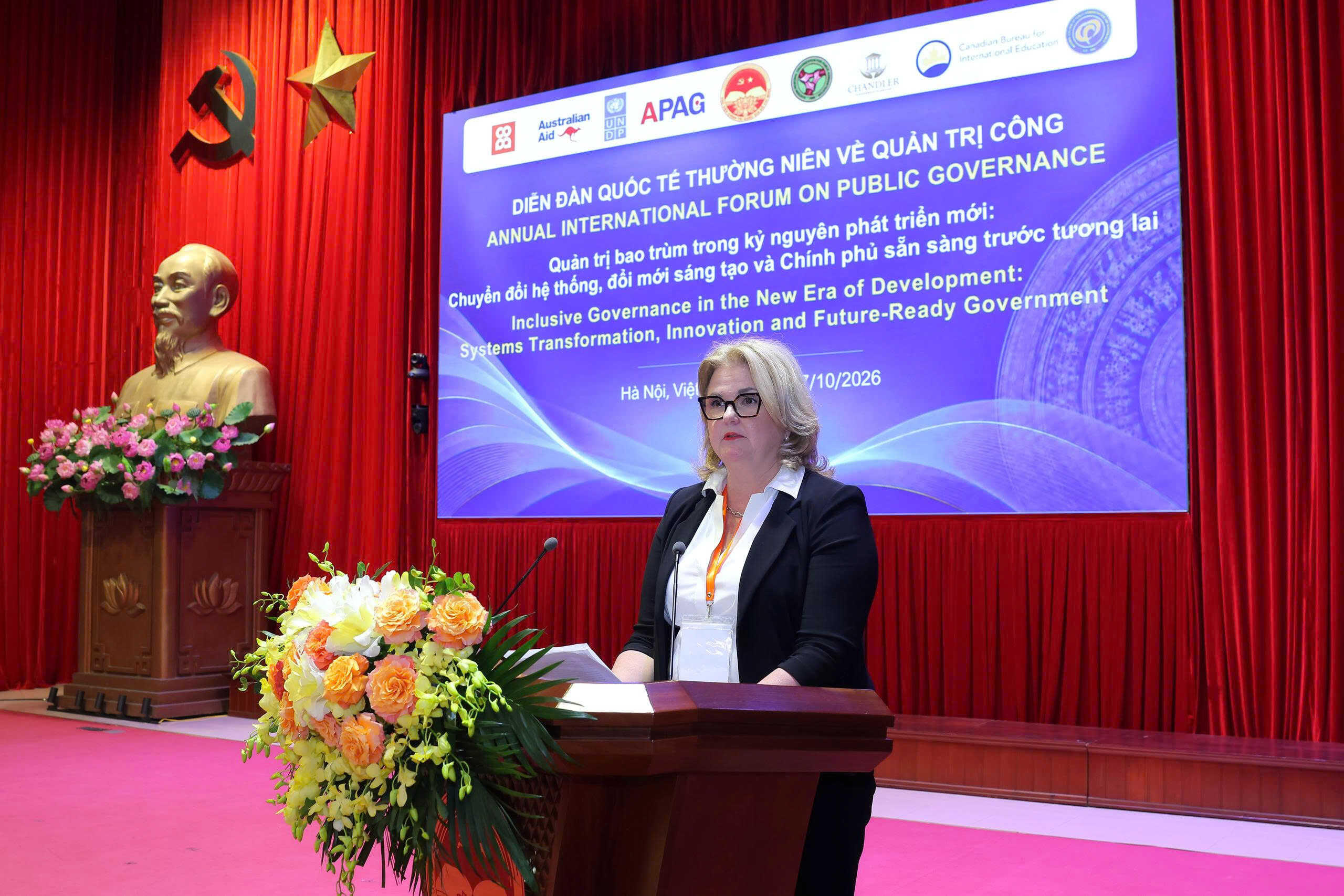 Ms. Karen Dalkie, Vice President of the Canadian Bureau for International Education (CBIE) and project director in Vietnam, delivers welcoming remarks
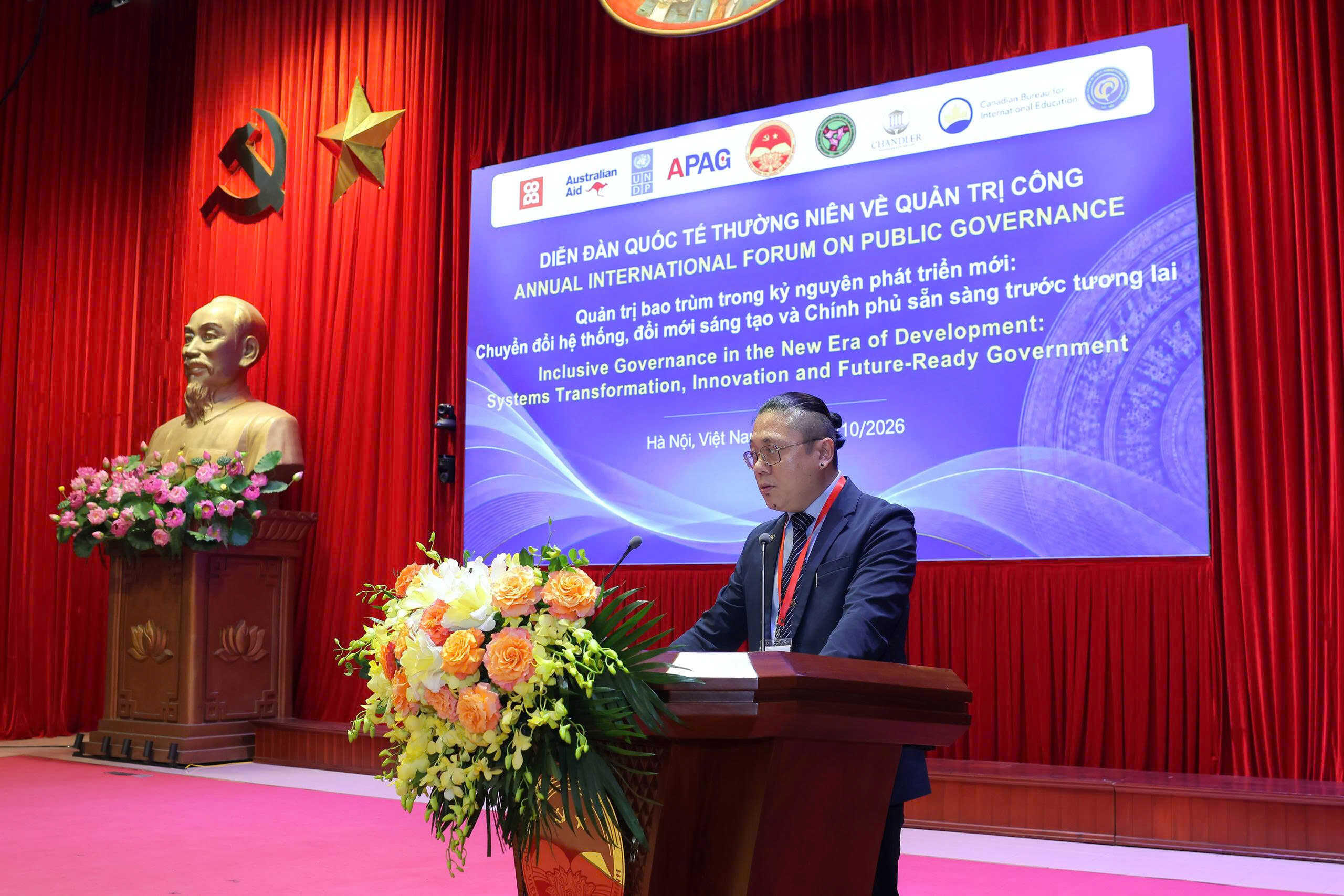 Dr. Kristoffer Berse, dean of the National College of Public Administration and Governance, University of the Philippines, and deputy secretary-general of EROPA, delivers welcoming remarks
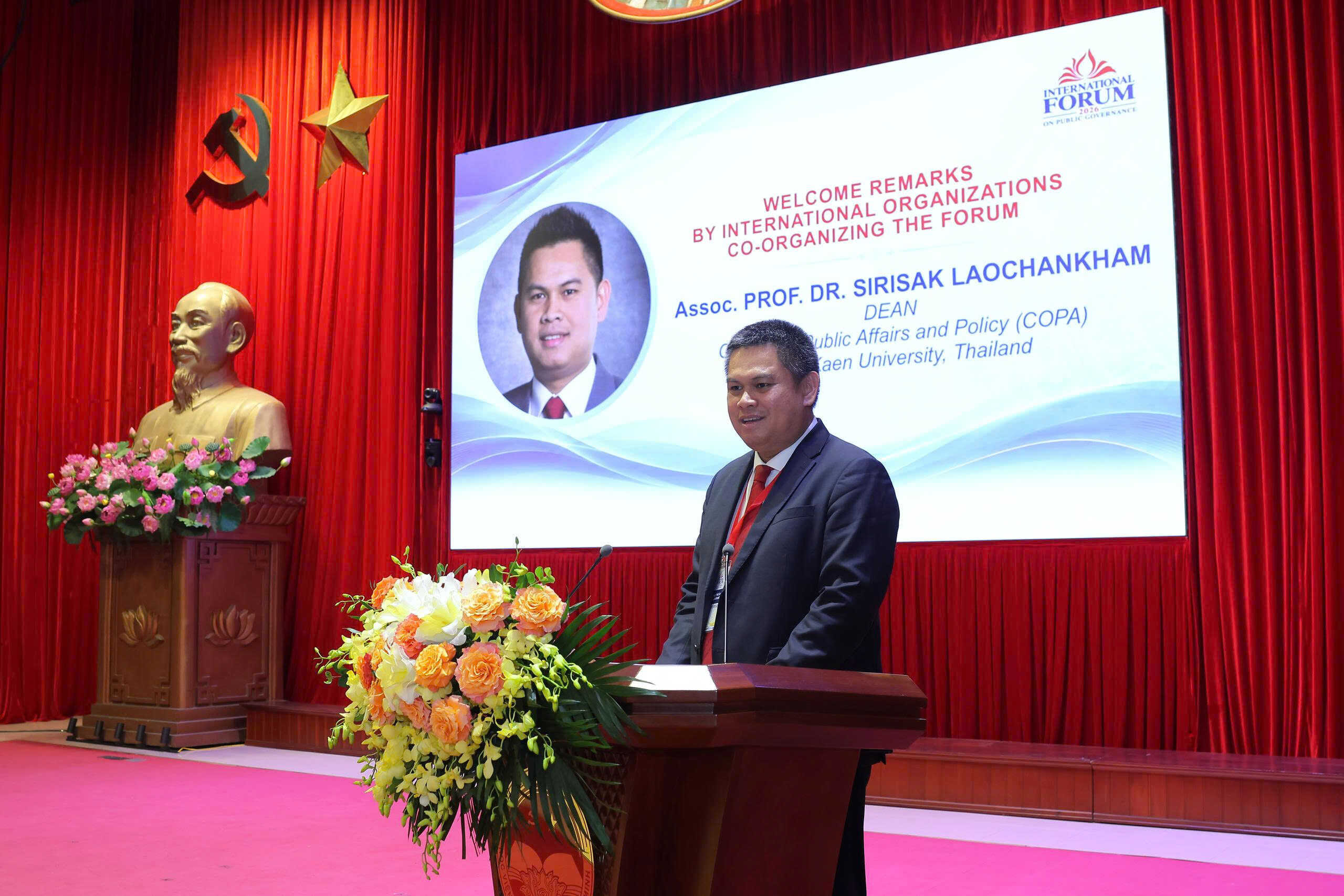 Assoc. Prof. Dr. Sirisak Laochankham, dean of the College of Public Affairs & Policy (COPA), Khon Kaen University, Thailand, delivers welcoming remarks
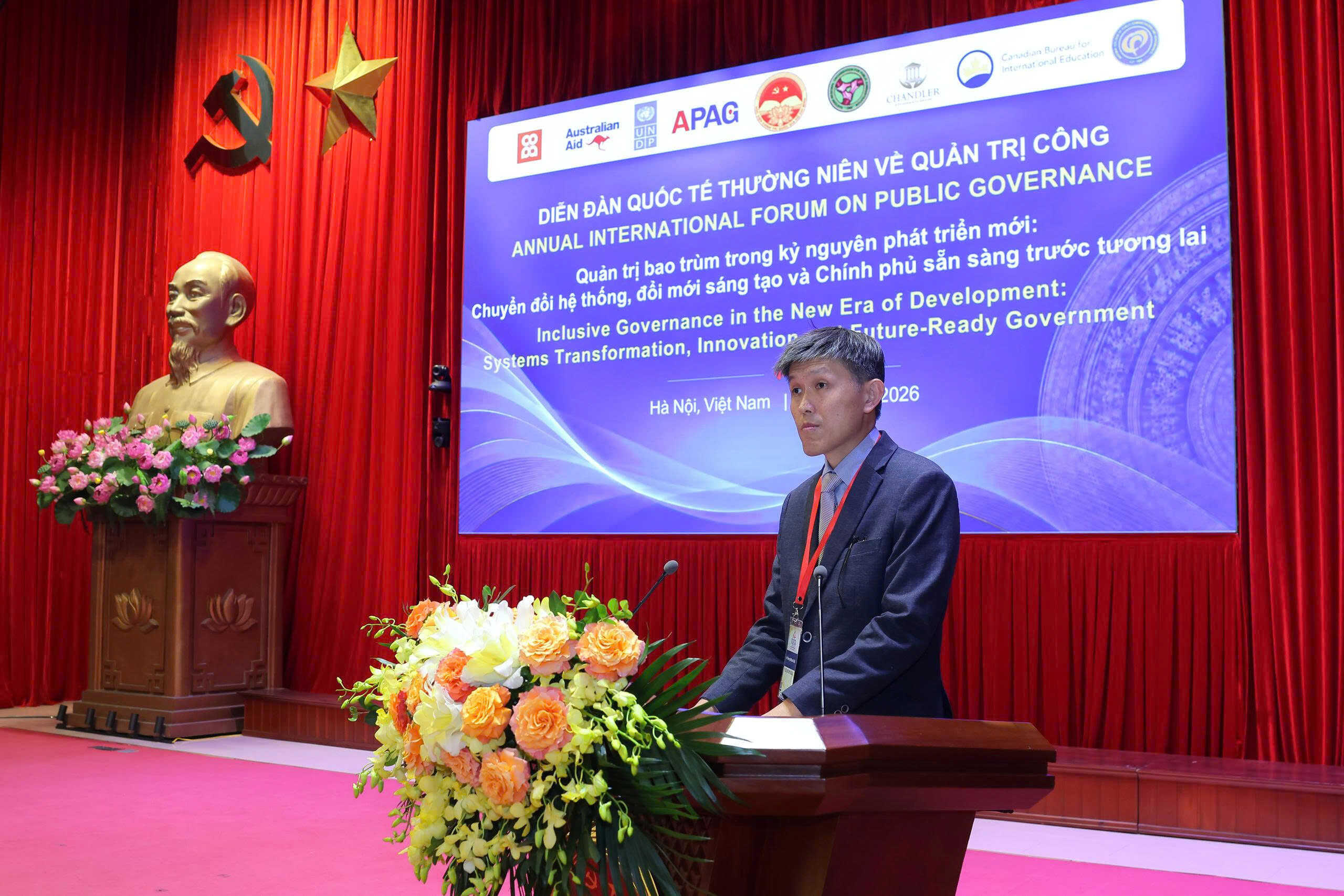 Mr. Heng Whoo Kiat, Director (Government Projects) at the Chandler Group of Governance (CGG), delivers welcoming remarks
Delivering welcoming remarks at the 2026 Annual International Forum on Public Governance, representatives of international organizations such as the Canadian Bureau for International Education (CBIE), the National College of Public Administration and Governance at the University of the Philippines (UP-NCPAG), the College of Public Affairs & Policy at Khon Kaen University (COPA Thailand), and the Chandler Group of Governance (CGG Singapore) expressed delight and honor at attending the event. Delegates expressed appreciation to the Ho Chi Minh National Academy of Politics and the Academy of Public Administration and Governance for organizing a meaningful forum as Vietnam enters a new development phase marked by profound economic, political, technological, and social shifts.
Delegates emphasized that through plenary sessions, policy dialogues, and thematic panels, the forum would focus on core issues facing public governance in the new era, spanning systemic transformation, institutional reform, decentralization, delegation of power, implementation and developmental creation capacity, sustainable development, digital government, artificial intelligence, data governance, and adaptive capacity to emerging challenges. Discussions also clarified the role of partnerships in mobilizing knowledge, technology, experience, and social resources, thereby strengthening connections between research, policy, and practice.
Representatives of international organizations expressed confidence that through panel discussions, the forum will advance international knowledge exchange, deepen theoretical and practical issues of national governance, and propose valuable recommendations for reform, governance innovation, and elevating Vietnam's developmental creation capacity in the new era.
The forum takes place over three days from October 5 to 7, 2026:
· October 5 (at the Ho Chi Minh National Academy of Politics): The opening ceremony, plenary sessions, and policy dialogues focus on key public governance issues in the new era: systemic transformation, institutional reform, decentralization, delegation of power, execution capacity, and developmental creation capacity.
· October 6 (at the Academy of Public Administration and Governance): 20 thematic sessions with over 100 papers examine 5 key clusters: development governance and sustainable development; systemic transformation and institutional reform; digital government, artificial intelligence, and data governance; future-ready government and adaptive governance; leadership, public sector capacity, and emerging challenges.
· October 7 (at the Academy of Public Administration and Governance): Discussion sessions continue to focus on institutional reform, partnerships, and mobilizing knowledge, technology, experience, and social resources for development; summarizing theoretical and policy issues surrounding national governance in the new era.
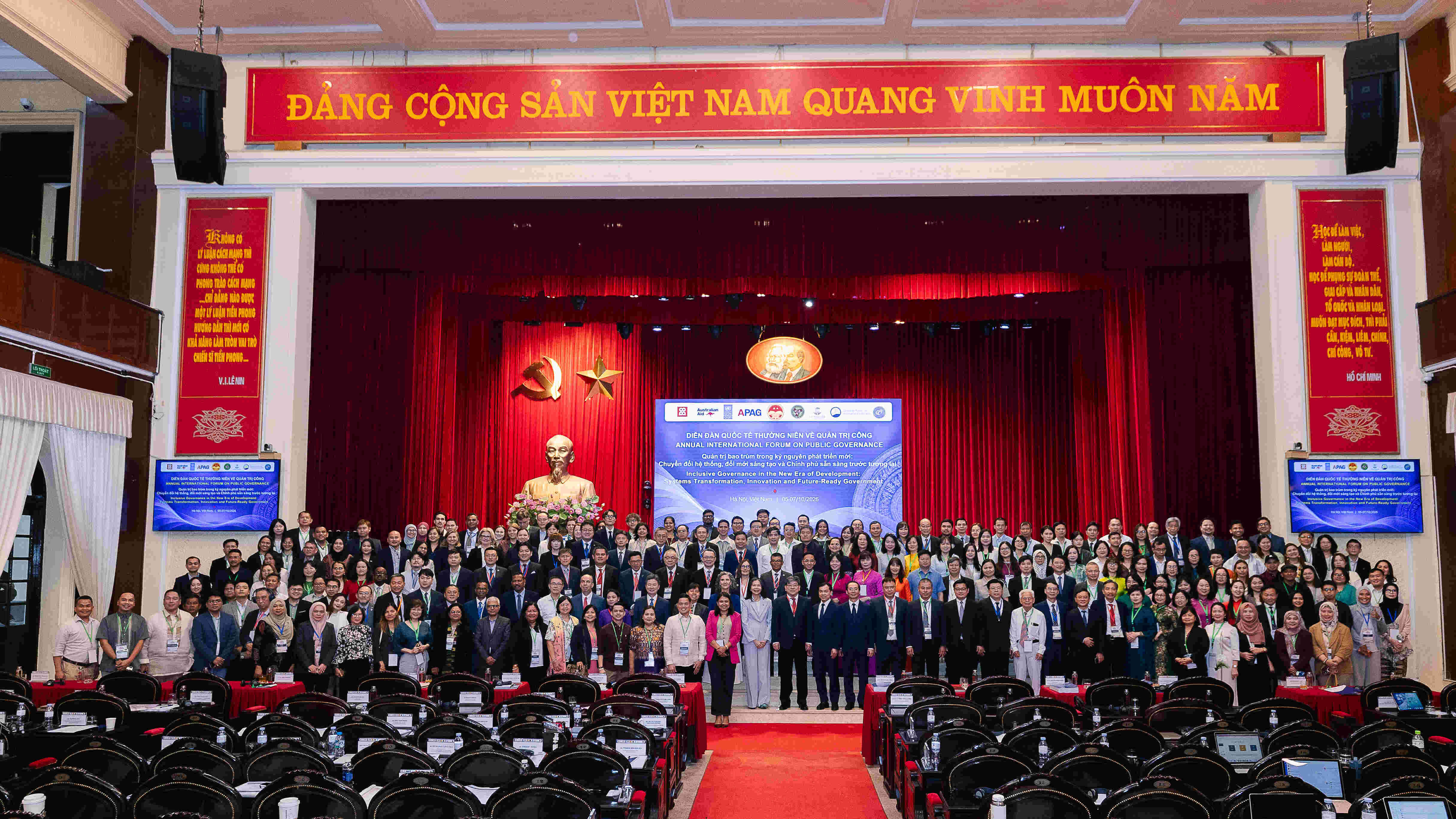 Delegates take a commemorative photo